Uhland Building Permit:Scott moved and Oswald seconded the motion to approve the building permit for Mr. and Mrs. Hayden Uhland in Sl2-Tl8-R49. Motion carried.
We’re not talking about Starlink being faster or better technology than ground based ISPs. We’re talking about ground based ISPs being dicks and charging way more their service than they need, and imposing data caps, throttling, providing horrendous customer service, and messing with and spying on their customer’s browsing. This is all happening because ground based ISPs don’t compete with each other, so customers have one choice of a decent ISP and can’t do anything about it. Starlink gives them a comparable service that will force other ISPs to compete against. If ISPs upgrade their networks and cut out all the crap they do, then yes, they could absolutely outperform Starlink. But right now, they have zero reason to do so.
It’s not that hard to come up with a reasonably good looking screen these days and be able to sell it for a few hundred dollars. The problem is there is a lot more to a monitor than just the display. It’s the software and the OS that separates the good and great monitors from the ok ones.
Profit margins are fair at 2x the price point for the channels I want, based on WHAT they are paying..
In my review of Joel Tator’s “Los Angeles Television” in the Feb. 25, 2015 issue of TV Technology, I praised the author for including information about Klaus Landsberg, the genius behind the second television station in Los Angeles, W6XYZ/KTLA.
Emil Bachev Bacheff Communications +1 9496673645email us here Visit us on social media:FacebookTwitterLinkedIn
3) To define, describe and forecast the Global Pulse Width Modulation (PWM) Controllers Market by type, application, and region.
To further test the range I set up a test where I could measure the exact distance at which the Cine 7 500 TX would work. Again this is going to depend on your location and wi-fi traffic in your area. I’m in the middle of Tokyo, so it should be a good indicator of how well the system works given the amount of wi-fi traffic and interference in this city.
Again, you didn’t actually look into it or don’t understand the technology. The satellites are ABSOLUTELY going to be communicating with one another as well as ground stations, both customer and uplink stations, and no it doesn’t require large and complex aerial systems. That’s the whole point. This ain’t the 80s man.
Up top sits an OLED display, which shows visual feedback for the current parameter – preset names, waveshape changes when tweaking oscillator settings, filter sweeps, envelope/LFO curves, etc. This real-time visualisation is both useful and aesthetically pleasing, and greatly enhances the overall programming experience as you dial in settings.
This was required by the FCC to gain approval to launch any satellites at all. So the answer is, yes.
Conceptually, optical AGC is simple to understand – more light means the receiver gain should be reduced to hold the output level constant. Unfortunately, that’s about where the simplicity ends with optical AGC. Implementing it can be challenging, particularly when the input optical range is increased to save costs at the system level. The problem with variable gain receivers with wide continuous adjustment range is that the relationship between the control voltage and amount of gain is usually a non-linear function whose characteristics change appreciably over temperature and typical manufacturing variances. The gain control circuit must map the optical power indicator into a unique control voltage with good accuracy. Such mapping was challenging, but achievable, for older optical input ranges; it becomes very daunting for wider optical input ranges, such as the -12 to +2 dBm range now contemplated. During receiver design, distortion and gain flatness considerations are normally at odds with the goal of having a desirable relationship between gain and control voltage. The addition of this extra requirement forces tradeoffs that increase complexity and cost. For example, a micro-controller may be programmed to perform the gain-shaping function, but with the drawback of a clock being added in the proximity of the receiver. Additionally, any variations in the level of modulation on incoming light or of the receiver’s gain with temperature will not be reflected in the optical AGC scenario. As we said, optical AGC is an open-loop correction scheme. The other approach is RF AGC, depicted in Figure 2. Here the RF signal leaving the receiver is directionally detected and sent to a feedback control loop containing an integrator. The control loop can easily be designed to absorb the non-linear relationship between the control voltage and the receiver gain; they are effectively absorbed by the high gain of the integrator in a closed-loop feedback system. In this case, device parameters that affect gain and change with time and temperature are corrected. Instead of the difficulty of open-loop gain alignment to achieve RF output control, the job becomes designing a temperature-compensated RF power detector – a much simpler task with surprisingly good results at low cost from multiple sources.
Zaxcom ZMT3-Flex | Digital Cable Tv Modulator Related Video:
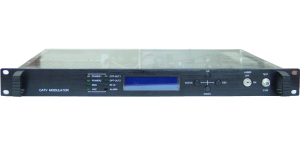
To meet the customers' over-expected gratification , we have our robust crew to offer our best over-all support which includes marketing, income, coming up with, production, excellent managing, packing, warehousing and logistics for Agile Catv Modulator, Catv Headend Rf Modulator 16 Channels, Ggort-B3 4 Output 23db Amp With Optical Input, Our Company policy is "quality first, to be better and stronger, sustainable development" . Our pursuit goals is "for society, customers, employees, partners and enterprises to seek reasonable benefit". We aspirate to do cooperate with all different the auto parts manufacturers, repair shop, auto peer , then create a beautiful future! Thank you for taking time to browse our website and we would welcome any suggestions you may have that can help us to improve our site.